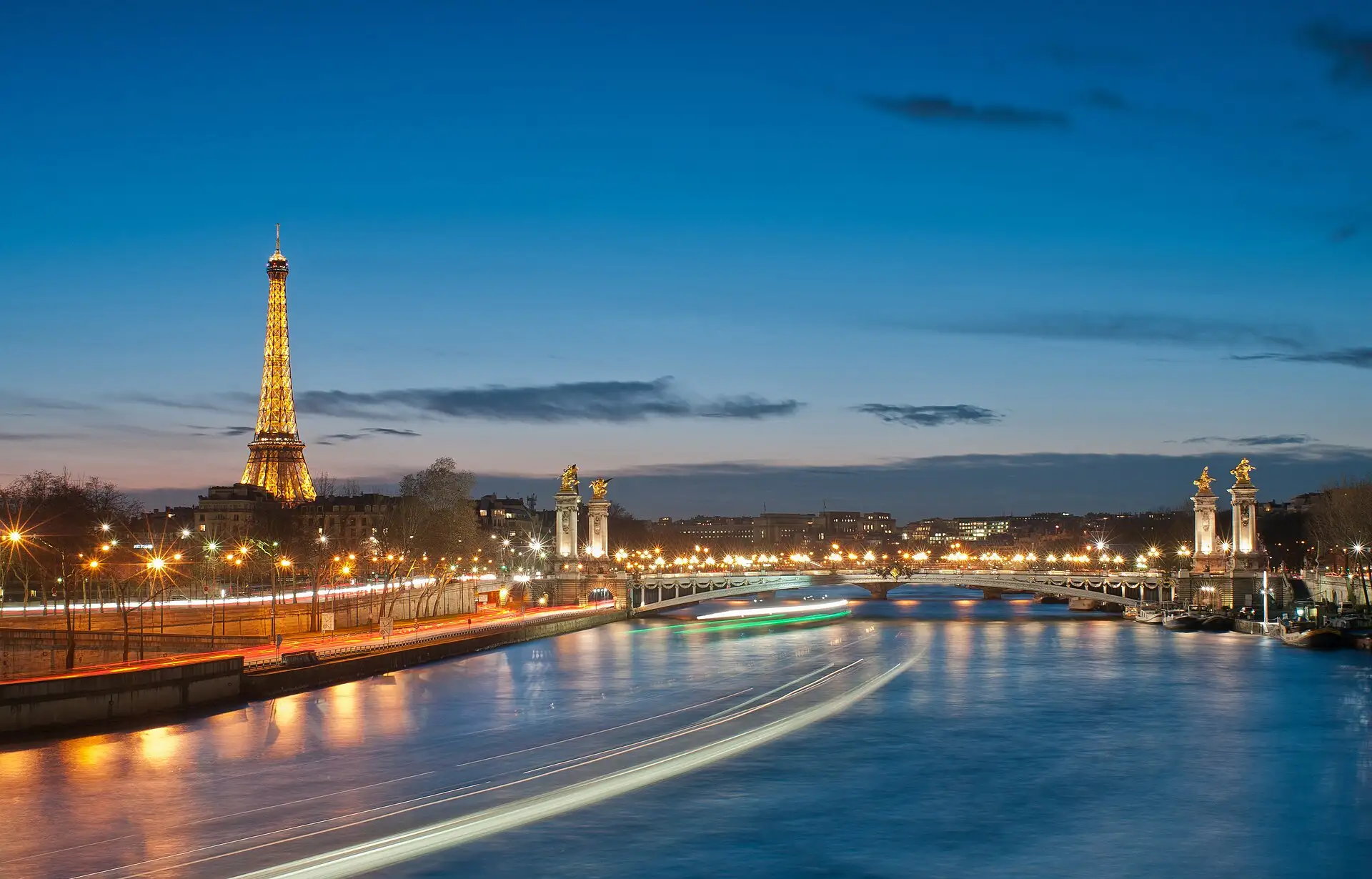
The Seine is the one sightseeing route in Paris with no traffic lights, no queues at the door and no bad seats. In one hour on the water you pass the Eiffel Tower, the Grand Palais, the Louvre, the Musée d’Orsay, the Conciergerie and Notre-Dame — monuments that would take a full day to walk between. That is why a Seine river cruise stays the single most-booked activity in the city, and why the choice of boats is now big enough to be confusing.
This site exists to un-confuse it. We compare every cruise format on the river — sightseeing, dinner, sunset, champagne, private — plus the operators behind them, with prices and schedules checked against official operator pages and the GetYourGuide listings where most travellers actually book. We don’t sell tickets and we are not affiliated with any boat company, so the recommendations don’t bend toward anyone’s fleet.
The four ways to cruise the Seine
Every boat on the river sells one of four experiences. Price is the fastest way to tell them apart.
| Format | Typical price | Duration | Best for |
|---|---|---|---|
| Sightseeing loop | €17–20 | 1 h | First visit, families, daylight photos |
| Evening / aperitif cruise | €25–35 | 1–1.5 h | City of lights, couples, value hunters |
| Lunch or dinner cruise | €60–170 | 2–2.5 h | Occasions, proposals, one big splurge |
| Private charter | €150+ | Flexible | Groups, events, zero strangers |
The entry point is the 1-hour sightseeing cruise, and the ceiling is a private charter with your own skipper. Between them sit the formats most people actually argue about at the hotel breakfast table: is the dinner cruise worth six times the price of the loop? (Short answer: as a meal, no; as an event, usually yes.) Is the night cruise better than the daytime one? (If you only do one — yes.)
What you see from the water
The classic circuit runs from the Eiffel Tower east to Île Saint-Louis and back, passing under a dozen bridges. In order, the right bank shows you the Palais de Tokyo, the Grand and Petit Palais, Place de la Concorde, the Tuileries and the Louvre. The left bank answers with the Musée d’Orsay, the Institut de France and the booksellers’ boxes on the quays. The turn happens around the two islands — Île de la Cité with Notre-Dame and Sainte-Chapelle, and the quieter Île Saint-Louis.
Two bridges get everyone’s cameras out: Pont Alexandre III, the gilded one built for the 1900 World’s Fair, and Pont Neuf, which despite its name (“new bridge”) is the oldest standing bridge in Paris, finished in 1607. Our river guide walks through all of it bridge by bridge, so you know what you’re looking at before the audio guide tells you.
When to go: the honest answer
Boats leave from about 10:00 until 22:00, and the light decides everything.
- Golden hour and sunset slots sell first, all year. In June–July that means roughly 21:00–22:00; in December, 16:30–17:00. See the sunset cruise guide for month-by-month times.
- After dark the city switches on: the Eiffel Tower sparkles for five minutes on the hour, and the monuments are floodlit. This is the night cruise, and it is the format we recommend to anyone who only has one evening.
- Late morning (10:00–11:30) has the shortest queues and the emptiest decks — the family-friendly window. More in cruising with kids.
Crowds peak between 14:00 and 17:00 from April to October. If you must go then, book online and arrive 20 minutes before departure; boarding closes 5 minutes before the boat leaves.
Which operator runs which boat
Six companies carry most of the traffic. Bateaux Mouches (since 1949) runs the huge open-top classics from Pont de l’Alma. Bateaux Parisiens and Vedettes de Paris depart from the Eiffel Tower — the former runs the big trimarans and the highest-rated dinner service, the latter the smallest and most manoeuvrable sightseeing boats on the river. Vedettes du Pont Neuf leaves from the tip of Île de la Cité, which makes it the natural pick if your hotel is in the Marais or Saint-Germain. Le Calife and Ducasse sur Seine are dinner specialists. Full profiles, menus and pier maps are in the operators section.
For week-long journeys — Paris to Rouen, Giverny and the Normandy coast — you leave the city boats behind entirely and board a river ship from Viking, AmaWaterways or Uniworld. That is a different product at a different price (€1,500–4,000 per person) and it has its own section.
How to buy tickets without overpaying
Three routes, in order of convenience:
- Online through an aggregator (GetYourGuide, Viator, Klook). Same or lower price than the pier, instant mobile ticket, free cancellation up to 24 hours on most listings. This is how the majority of the reviews you’ll read were booked. Our comparison of booking sites shows where each one wins.
- The operator’s own website. Sometimes has exclusive slots (first departure, jazz evenings). Worth checking for dinner cruises where seating category matters.
- The ticket window at the pier. Fine for daytime loops outside summer; risky for anything at sunset or with food.
A note on “skip-the-line” wording: on sightseeing boats there is rarely a separate fast lane — an online ticket simply lets you walk past the ticket-buying queue to the boarding queue. That is still worth it in July. Details and current fares are on the tickets and prices pages.
Checked in practice: if the boarding queue at the Eiffel Tower piers looks hopeless, walk 10 minutes downstream to Port de Suffren or cross to Pont de l’Alma — the same river, the same monuments, and often a departure 15 minutes sooner.
Beyond the classic loop
The Seine is not the only water in Paris. The Canal Saint-Martin cruises chug through four double locks and a 2-kilometre vaulted tunnel under the Bastille — slower, stranger and beloved by return visitors. Seasonal formats appear too: Christmas and New Year’s Eve cruises with gala menus, and spring champagne tastings on electric boats. If someone in your party is planning a proposal, the romantic cruise guide ranks the formats by privacy per euro.
Wherever you land, the rule that saves the most money is simple: decide the time of day first, the format second, and the operator last. The river does most of the work regardless of the hull you’re standing on.
Frequently asked questions
How much does a Seine river cruise cost?
Standard 1-hour sightseeing cruises cost €17–20 per adult. Evening cruises with a drink run €25–35, lunch cruises €60–90, and dinner cruises €114–170 depending on menu and seating. Private boats start around €150–200 for small groups. Prices are taken from GetYourGuide and official operator pages and change with the season.
Do I need to book a Seine cruise in advance?
For daytime sightseeing loops you can usually buy on the spot, but online tickets are often cheaper and let you skip the ticket desk. Dinner cruises, sunset slots in summer, and holiday dates sell out days or weeks ahead — book those early.
What is the best Seine river cruise?
It depends on budget and time of day. The 1-hour cruise from the Eiffel Tower is the best first-timer choice (€18, departures all day). For atmosphere, take an evening cruise around sunset. For a special occasion, Bateaux Parisiens' 3-course dinner cruise is the highest-rated full-dinner format.
How long is a Seine river cruise?
Sightseeing loops last about 1 hour. Lunch cruises take around 2 hours, dinner cruises 2 to 2.5 hours. Canal Saint-Martin combination cruises run 2.5 hours. All round trips return to the departure pier.
Do Seine cruises run in winter and in the rain?
Yes. Boats are covered and heated, and cruises run every day of the year including December and January. Open-deck seating closes in bad weather, but the panoramic salons stay open. Winter evenings are actually a good time to see the illuminations with fewer crowds.
Where do Seine cruises depart from?
The main piers are Port de la Bourdonnais and Port de Suffren at the Eiffel Tower, Port de la Conférence at Pont de l'Alma (Bateaux Mouches), and Square du Vert-Galant at Pont Neuf (Vedettes du Pont Neuf). Every operator page on this site lists the exact pier and nearest métro station.
Is a Seine river cruise worth it?
For a first visit to Paris, yes — it is the only way to see the Louvre, Musée d'Orsay, Notre-Dame and the Eiffel Tower from the water in a single hour, and at €17–18 it is one of the cheapest major experiences in the city. Skip it only if you have already done it and prefer walking the banks.