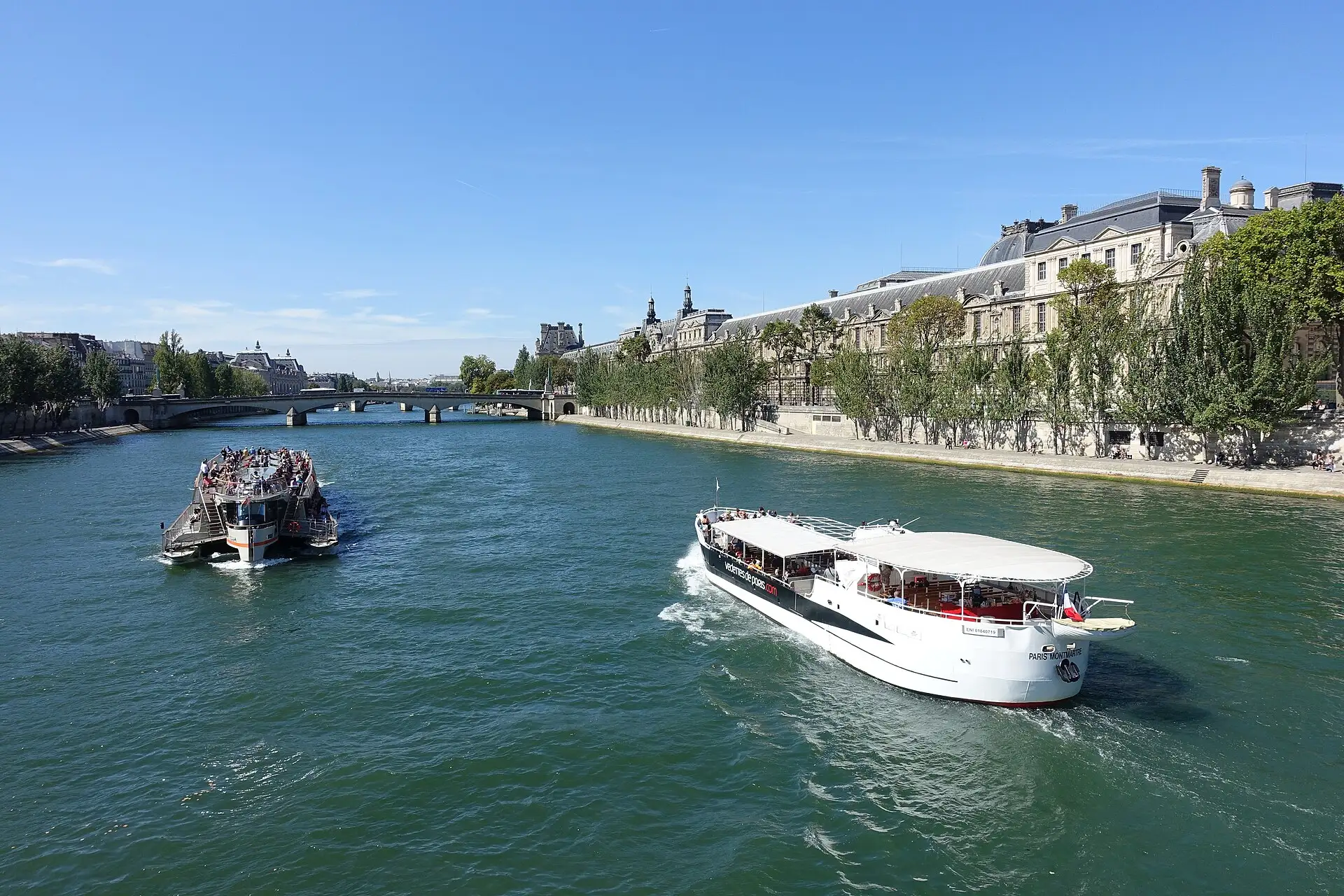
The one-hour Seine river sightseeing cruise is the standard unit of Paris tourism: €17–18, a fixed loop between the Eiffel Tower and the islands, and more monuments per minute than any walking route could manage. Roughly every major operator sells the same circuit under a different brand, which is precisely why it pays to know what the hour contains, where the boats differ, and which seat turns a good loop into a great one.
Below: the route minute by minute, audio guide realities, the open-deck-versus-salon decision, how the operators compare on identical water, and notes for families and wheelchair users. Prices and ratings are from GetYourGuide listings and move with the season — confirm on the booking page.
The loop, minute by minute
Timings below assume the flagship departure from Port de la Bourdonnais at the Eiffel Tower, sailing east first; other operators run the same circle from a different starting point, so shift the sequence accordingly. River traffic stretches or compresses any leg by a few minutes.
| Minutes | What you pass |
|---|---|
| 0–5 | Cast-off beneath the Eiffel Tower; the best full-height view of it you will get all hour is behind you — shoot now |
| 5–12 | Right Bank: Palais de Tokyo and the Trocadéro hill astern, then the glass roof of the Grand Palais ahead |
| 12–18 | Pont Alexandre III — gilded statues, built for the 1900 World’s Fair — then Place de la Concorde’s obelisk glimpsed up the axis |
| 18–25 | The Louvre stretches along the left side for the better part of a kilometre; Musée d’Orsay’s clock faces answer from the right |
| 25–32 | Pont Neuf, the oldest bridge in Paris, finished in 1607 — then the boat threads between Île de la Cité and the banks |
| 32–40 | Notre-Dame: the boat rounds the eastern tip of Île de la Cité and passes Île Saint-Louis, the quieter of the two islands, before turning |
| 40–48 | Return leg along the opposite bank: the Conciergerie’s towers, the Latin Quarter quays, the bouquiniste boxes above |
| 48–55 | Back past Orsay and the Grand Palais from the other side; second pass of Pont Alexandre III |
| 55–60+ | The Eiffel Tower grows ahead and to one side; final approach and docking |
The turn at the islands is the halfway hinge: everything you saw outbound repeats inbound from across the river, which is why missing a monument on the first pass never matters and why neither side of the boat is a wrong answer.
Audio guide: what to expect
On the big boats the commentary is recorded, triggered by GPS, and delivered in roughly ten or more languages through headsets, seat handsets or an app on your own phone with your own earphones. It names what you are passing with a sentence or two of context — orientation, not a lecture. Take the headset even if you think you know Paris; the river-facing facades have different stories than the street sides.
Two variations worth knowing. Vedettes de Paris sells departures with a live bilingual guide, which converts the hour into something closer to a tour and is the better pick for curious teenagers and first-timers who ask “what’s that?” every bridge. And the cheapest evening loops sometimes run commentary-free — fine at night when the lights carry the show, thin by day.
Open deck vs salon
Every large sightseeing boat is split between an open upper deck and a glassed lower salon, with free movement between them.
- Open deck is the default choice: unobstructed photos, the sound of the river, and the pass under each bridge felt rather than watched. Downsides: sun with no shade in summer, wind always, and the best rail positions go to whoever boarded first.
- Salon wins in rain and cold, for grandparents who want a seat with a table, and for toddlers you would rather not chase around a deck. The glass is kept clean but adds reflections to photos — press the lens to the pane.
The professional move is both: board 20 minutes early, take a deck rail for the first half, and drop below at the islands turn once your camera roll is full. On peak summer afternoons the deck fills within minutes of the gangway opening, so boarding time is seat strategy.
Local tip: skip the 11:00–17:00 departures in July and August entirely and book the first sailing of the morning instead. Same €18, a third of the passengers, low side-light that flatters the facades, and the river before the tour groups — the closest the standard loop comes to feeling private.
Same loop, different operators
The water is identical; the differences are pier, boat size and boarding style.
| Operator | Departure pier | Boat style | Angle |
|---|---|---|---|
| Bateaux Parisiens | Port de la Bourdonnais (Eiffel Tower) | Large glass-topped ships | The €18 flagship loop, 4.4 from 89,000+ reviews; departures all day |
| Bateaux Mouches | Pont de l’Alma (Right Bank) | The classic large open-stern boats | The original brand, on the river since 1949; evening loop from €17 |
| Vedettes de Paris | Port de Suffren (Eiffel Tower) | Mid-size boats | Fast-access boarding, live-guide options, less industrial feel |
| Vedettes du Pont Neuf | Square du Vert-Galant (Pont Neuf) | Mid-size boats | Starts mid-loop at the islands — ideal if your day is based around Notre-Dame or the Louvre |
Choose by geography and hour, not by brand loyalty: if you are at the tower, board there; if your afternoon ends at Notre-Dame, Pont Neuf saves you a métro ride. Detailed fleet-by-fleet reviews live in our Bateaux Parisiens review and the wider operators section, and the head-to-head rankings are on the best cruises page.
Families, and who this format suits
This is the family format on the river. One hour sits inside almost any child’s tolerance, the scenery changes every two minutes, decks are railed, salons are stroller-friendly, and under-fours typically travel free. The snack bar sells drinks and ice cream at captive-audience prices — bring your own water. If your children need more than scenery, a dedicated family cruise with child-focused animation exists as a step up.
The format also suits the jet-lagged first evening, the four-hour layover-style visit, and anyone assembling a first-day mental map of Paris: an hour on the river fixes the geography of both banks better than any bus tour. What it does not do is show interiors or neighbourhoods beyond the quays — treat it as the aerial photo of your trip, then walk the details.
Accessibility notes
Main decks on the large Bateaux Parisiens and Bateaux Mouches vessels are step-free from the quay via ramps, and crews routinely assist wheelchair users at the gangway; the open upper decks, reached by stairs, usually are not accessible. The catch is the ramp itself: its slope changes with the river level, and after heavy rain it can be steep. Accessible toilets exist on the newer large boats but not universally. For a guaranteed smooth boarding, message the operator via the official website with your date rather than relying on the aggregator listing.
Boarding, step by step
The process is the same across the big piers, and knowing it removes the only stressful part of the hour:
- Find the exact pier, not the neighbourhood. “Eiffel Tower” on a ticket covers two separate quays several minutes apart — Port de la Bourdonnais and Port de Suffren. The pier name is on the voucher; match it to the quay signage, not to the biggest queue. The Eiffel Tower departures page maps both.
- Arrive 20–30 minutes early. Mobile vouchers scan directly at the gangway on most operators; a few ask you to swap the voucher for a boarding card at the quay kiosk first — the listing says which.
- Security is a bag glance, not an airport. Large luggage is refused; daypacks are fine. There is no cloakroom on sightseeing boats.
- Board and go straight up. Seating is unassigned on standard loops. The open-deck rails fill first, bow before stern — and the stern is the underrated position, holding both banks and the wake in one view.
- Missed the boat? Tickets for frequent-departure loops are usually valid on the next sailing at the operator’s discretion — ask at the kiosk before buying again.
Toilets and a small bar are aboard the large vessels; neither exists on some smaller boats, worth knowing with children after a long quayside wait.
Booking the hour
Same-day booking works most of the year — departures leave every 30 to 60 minutes from morning until late evening, and the big boats swallow crowds without visible strain. Book a day or two ahead only for summer weekends and for the specific golden-hour and night slots, which the sunset and night cruise pages cover in detail. Tickets are cheapest and simplest through the standard listings; the mechanics, mobile tickets and cancellation rules are walked through on the tickets guide.
One honest caveat to end on: the one-hour loop is the best value on the river precisely because it promises little and delivers exactly that — sixty minutes, twenty monuments, no surprises. If you finish it wanting the same route with a drink, dusk light or dinner, the river has a format for each; this page’s hour is where everyone should start.
What we like
- The densest sightseeing hour in Paris: most major monuments in one sitting, no queues at any of them
- Departures every 30–60 minutes mean it slots into any itinerary gap
- At €17–18 it is the cheapest of all Seine cruise formats
- Works identically in rain — the glassed salon keeps the full view
- Genuinely child-friendly: short, seated, and something new every two minutes
What to watch out for
- Commentary is recorded and brief on most boats — this is orientation, not a history lecture
- Peak-hour boats (11:00–17:00 in summer) load hundreds of passengers; the open deck fills fast
- You see facades from the water, not interiors — it complements walking, never replaces it
- Snack-bar prices on board are steep; eat before or after
Frequently asked questions
How long is a Seine river sightseeing cruise?
The standard loop runs 60 minutes, sometimes stretching to 70 with river traffic and locks of passenger flow at the pier. Add 20–30 minutes for boarding before departure. Longer sightseeing formats exist — aperitif cruises run closer to 90 minutes and dinner cruises 2–2.5 hours — but the classic one-hour circuit is the default product on the river.
How much does a 1-hour Seine cruise cost?
Standard adult fares are €17–18: the Eiffel Tower one-hour cruise lists at €18 and the Bateaux Mouches evening loop at €17 on GetYourGuide. Children's fares run lower, and children under about four typically sail free — check each listing. Prices are near-identical across operators for the same loop, so choose on pier location and timetable rather than a euro of difference.
What languages is the audio guide in?
The major operators provide commentary in roughly 10 or more languages — English, French, Spanish, German, Italian and Portuguese are standard, with Mandarin, Japanese, Korean and Russian common on the bigger fleets — delivered by headset, handset or a smartphone app. Some Vedettes de Paris departures use a live French/English guide instead. Confirm your language on the listing before booking.
Is the open deck or indoor salon better?
Open deck, if weather allows: no glass between you and the view, and photos improve immediately. The glassed lower salon wins in rain, cold or strong sun with small children. Board early and you can usually claim a deck bench and retreat below later. In July–August the deck fills within minutes of boarding, so treat boarding time as part of the seat strategy.
Are Seine sightseeing cruises good for kids?
Yes — this is the most child-proof format on the river: one hour is within most attention spans, seating is unassigned, decks have railings, and there is a snack bar on the big boats. Strollers board fine at the main piers. Under-fours usually sail free. The dedicated family cruise with animateurs is an alternative if you want entertainment aimed at children rather than an audio guide.
Are the boats wheelchair accessible?
The main decks of the large boats at Port de la Bourdonnais and Pont de l'Alma are generally step-free from the quay ramp, and crews assist at the gangway. Upper open decks are reached by stairs on most vessels, so wheelchair users typically stay on the main level. Ramp gradients vary with the river height — contact the operator through the official website before travelling.
Do all operators sail the same route?
Essentially yes: every one-hour boat runs the Eiffel Tower–islands corridor, differing only in starting point, which shifts where the loop begins rather than what it contains. Bateaux Parisiens and Vedettes de Paris start at the tower; Bateaux Mouches starts at Pont de l'Alma; Vedettes du Pont Neuf starts mid-loop at the islands. Pick the pier that fits your day's geography.